

- Build in the crate
- 7.0.0
- Made by the team at
- MKLabs Co.
- Menu languages offered
- English
- How you pay for it
- Included
- macOS it plays on
- macOS 10.13 or later
- CPU it runs on
- Apple Silicon, Intel 64-bit
Screenshots
A software architect sketches a class diagram on a MacBook, then generates Java code from it — that’s the kind of workflow StarUML supports. This visual modelling tool covers UML 2.x diagrams (class, sequence, component, deployment, activity, use case, state) plus BPMN 2.0 and Entity-Relationship diagrams. Version 7 introduces device-based licensing, Mermaid support, Azure architecture diagrams, and AI integration through an MCP server. You can also import existing code for reverse engineering and extend functionality with third-party plugins for Java, C#, C++, and Python. It runs on macOS 10.13 or later, works on both Intel and Apple Silicon, and the interface is in English.
Plugin architecture and reverse engineering
The app uses a plugin architecture, so you can add code generation or tool integrations as you need them. People often ask whether it handles both forward and reverse engineering — yes, through those plugins. The Mermaid support in version 7 means you can export diagrams in a text-based format that works well in documentation tools.
Device-based license on first launch
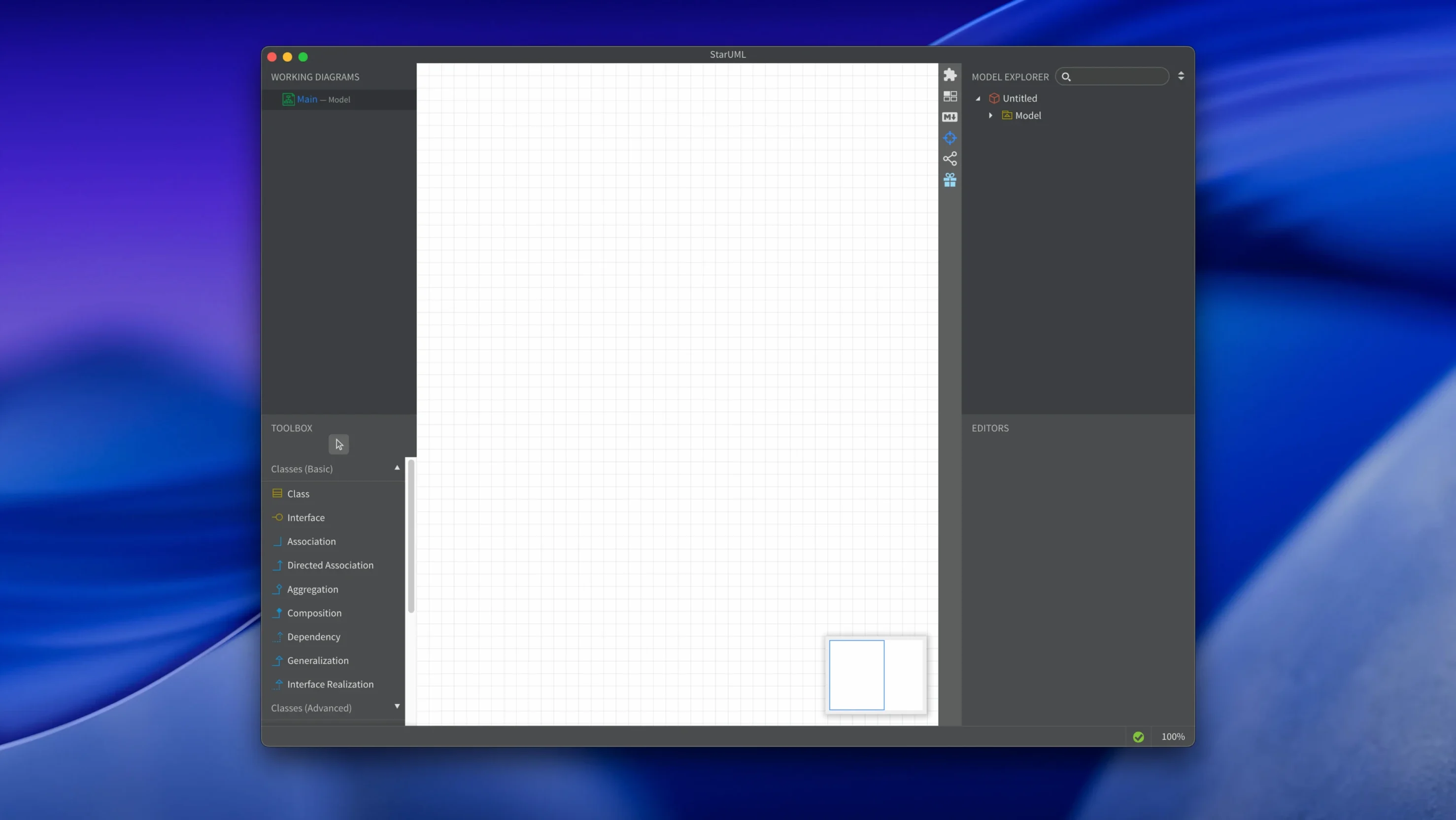
When you open StarUML for the first time, the licence screen appears because version 7 uses device-based licensing. The app registers your machine automatically, so you don’t need to enter a key or sign in — just confirm the device and you’re in. After that, the default workspace shows a blank project with an empty diagram canvas. I’d recommend starting with a simple class diagram to get a feel for the palette and the drag-and-drop placement.
A couple of practical things for the early days:
- Set up the diagram template you use most often. The app remembers your last project type, so opening a new one each session is quicker.
- Try the Mermaid export right away. Draw a small sequence diagram, then export it — the text output is handy if you keep documentation in Markdown or a wiki.
- Check the plugin manager under the Tools menu. The default install includes the code generation plugins for Java, C#, C++, and Python, but you can enable or disable them depending on your language stack.
Sketching a deployment diagram for a web service
Let’s say you’re sketching the architecture for a new web service. You open StarUML, create a new project and pick the deployment diagram type from the model explorer on the left. The palette offers nodes for servers, storage, and network connections. You drop a couple of server nodes onto the canvas, label them, and link them with association lines.
After the infrastructure looks right, you switch to a component diagram. The model explorer keeps everything in one tree, so you can drag the server nodes from the deployment view into the component diagram as references. That’s useful when you want to show which components run on which hardware without redrawing everything.
Next, you add a use case diagram to capture the main user interactions. The palette for use cases includes actors, use case ovals, and system boundaries. You place three actors — a customer, an admin, and a third-party API — then draw the relationships. Each use case can hold a short description in the properties panel on the right, so you don’t need a separate document for notes.
With the high-level design done, you move to a sequence diagram to detail one specific flow. The lifelines snap into place automatically, and messages between them are a simple click-and-drag. If you need to show an alternative flow, the combined fragment tool draws the frame and labels it.
Finally, you generate code from the class diagram. With the Java plugin enabled, you select the classes you want, right-click, and choose the generate option. The output appears in a new panel — you can save it directly to your project folder. The reverse engineering feature works the same way: import existing source files, and StarUML builds the corresponding diagram from the code structure.
Before closing, you export the deployment and component diagrams as images and the sequence diagram as Mermaid text. The whole session — from empty project to exported diagrams — feels straightforward once you’ve placed the first few elements.
- Device-based licensing model
- Mermaid support
- Azure architecture support
- AI integration via MCP
- macOS 10.13 or later
- Intel or Apple Silicon
Kit check at a glance
| System | macOS 10.13 or later |
| Chip | Apple Silicon, Intel 64-bit |
| Download | 129 MB |
| Older pressings | 2 in the crate |







Chat from the booth
Sign in or grab a free account to leave a comment.
Nobody has said a word in the booth yet. If you played a set with this build, tell the next person how it went.