
- Build in the crate
- 1.0.5
- Made by the team at
- Sage Audio
- Menu languages offered
- English
- How you pay for it
- K'ed by Team X-db
- macOS it plays on
- macOS 10.13 or later
- CPU it runs on
- Apple Silicon, Intel 64-bit
Screenshots
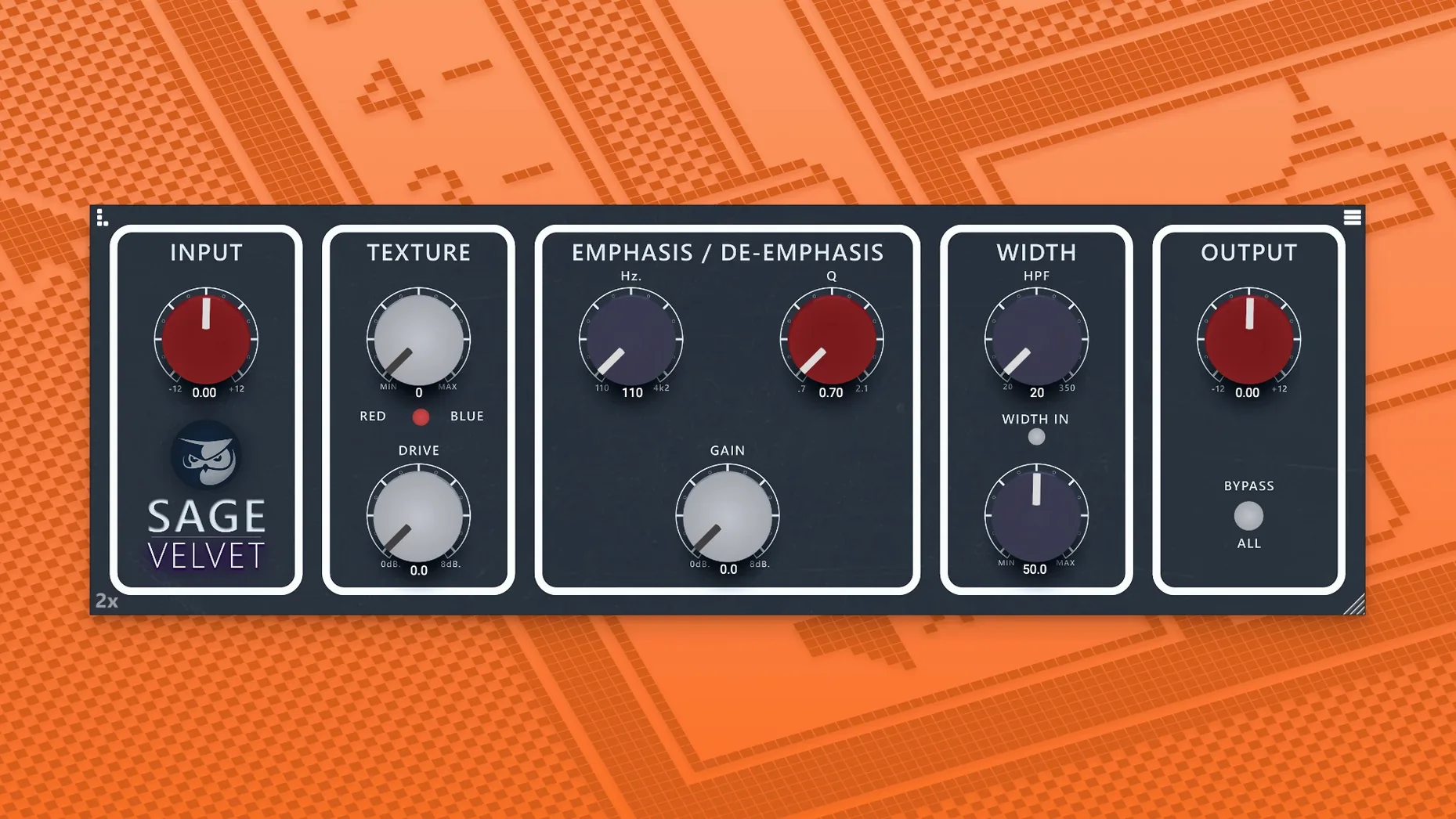
If you already reach for saturation plugins to add warmth and glue, Sage Velvet does something a bit different. It recreates the subtle behaviour of a modern analog device, focusing on the traits that usually get lost in digital emulations: the way it responds to dynamics, the slight emphasis shift across frequencies.
on a single track
Drop it on a vocal or a bass line. The drive function pushes the signal without obvious distortion, and the built-in filter leaves the low end alone, so you get harmonic colour without mudding up the sub frequencies. It works as a set-and-forget processor that stays clean until you really lean into it.
on a bus or group
On a drum bus or a synth subgroup, the emphasis/de-emphasis filter preserves the frequency balance while adding width. The plugin is designed to handle an entire track’s signal, so it behaves predictably when you sum several channels through it.
on the mix bus or master
The filter prevents the lowest frequencies from piling up, and the width control helps you shape the stereo field without breaking the centre. It is one of the first plugins to reproduce the small, hard-to-measure details of analog hardware.
Native support for M1 and M2 Macs
One thing that comes up often is whether the plugin works with an M1 or M2 Mac. Sage Velvet runs natively on both Intel and ARM systems, so you do not need Rosetta for Apple Silicon machines. It is 64-bit only, so older 32-bit hosts will not load it.
Another question is about the format. The plugin comes in AAX, VST3 and AU, which covers Pro Tools, Logic, Ableton Live and most other modern DAWs. If you use an older DAW that only supports VST2, you might need to check compatibility before installing.
Activation is handled through the included instructions. If you run into problems, the advice is to block internet access during activation. The package is already pre-activated, so it should work without extra steps on most systems.
Avoiding drive overload in Red and Blue modes
A common one is cranking the drive too far on the first try. The Red and Blue modes have different saturation characters, and pushing the drive to maximum on both can overload the mix. Start with the drive low and listen to how the emphasis filter responds before turning it up.
Another mistake is ignoring the built-in low-frequency filter. Beginners sometimes add extra EQ cuts later because the low end sounds loose, when the filter inside Sage Velvet already prevents that. Let the plugin handle the sub frequencies and adjust the width control instead.
People also forget to check which mode they are in. Red and Blue behave differently, so switching mid-project without listening can change the tone unexpectedly. Pick one mode early and stick with it through the session.
- macOS 10.13 or later
- 64-bit only
- Intel or Apple Silicon (native)
- Interface language: English
Kit check at a glance
| System | macOS 10.13 or later |
| Chip | Apple Silicon, Intel 64-bit |
| Download | 165 MB |
| Older pressings | 1 in the crate |





Chat from the booth
Sign in or grab a free account to leave a comment.
Nobody has said a word in the booth yet. If you played a set with this build, tell the next person how it went.