
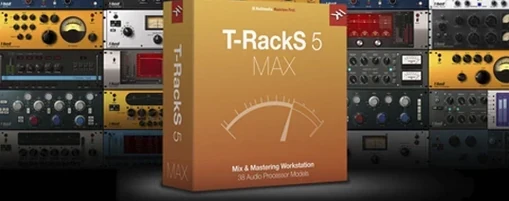
- Build in the crate
- 6.3.2
- Made by the team at
- IK Multimedia
- Menu languages offered
- English
- How you pay for it
- K'ed by MORiA
- macOS it plays on
- macOS 10.15 or later
- CPU it runs on
- Apple Silicon, Intel 64-bit
Screenshots
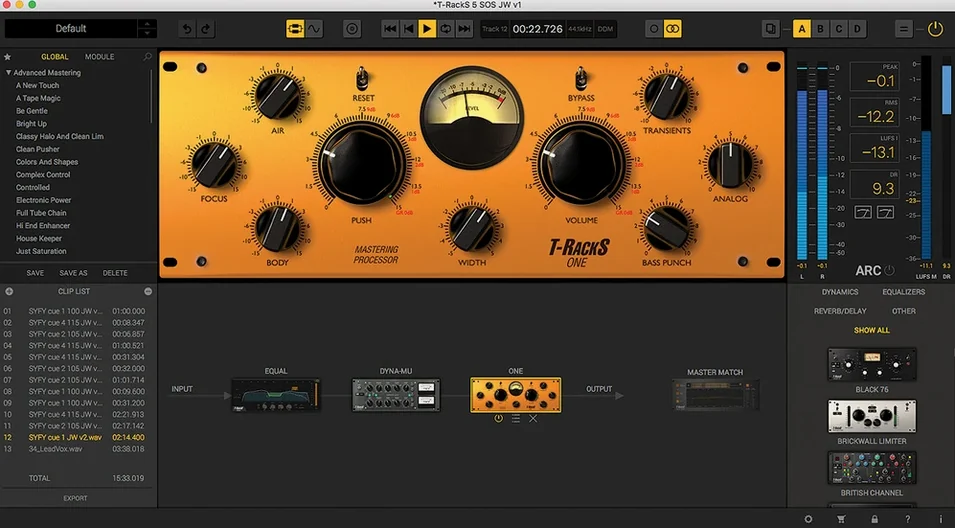
Four new processors land in T-Racks 6.3.2: Master Match, Dyna-Mu, EQual, and ONE. That’s a lot of tonal shaping in one update, and the redesigned graphical user interface makes it easier to see what each module is doing to your mix.
Dyna-Mu tightens low end, EQual shapes five bands
Dyna-Mu is a classic opto-style compressor with a single threshold knob and a ratio that follows the input. Push it gently and the low end tightens; push harder and the whole bus starts to breathe. EQual is a five-band EQ with a musical curve, so you can cut mud at 200 Hz or add air at 12 kHz without the mix falling apart. Master Match listens to your track and suggests EQ curves to match a reference — handy when you want consistency across an album.
Standalone console or DAW plug-ins on Intel and Apple Silicon
You can run T-Racks as a standalone Mastering Console, or load each processor as an individual plug-in in your DAW. The 64-bit version covers both Intel and Apple Silicon Macs, and the Module Manager keeps everything organised. Album assembly with sequencing and metadata embedding means you can finish a record without leaving the app. Installation follows the standard macOS procedure after you download the file.
Open the standalone console first, hide unused modules
Once the standard installation finishes, open the standalone Mastering Console before you touch anything in your DAW. The Module Manager shows every processor you have available — it’s worth hiding the ones you never use right away so the list stays clean. Load a finished mix and try Master Match first: pick a reference track you know well and let it suggest an EQ curve. You’ll hear immediately whether the analysis fits your taste. If it doesn’t, tweak the curve manually; the point is to get a feel for how the new GUI responds to mouse drags and fine adjustments.
Then drop Dyna-Mu on the master bus with the threshold at about -10 dB and listen to how the low end changes when you push the input harder. This is a good way to learn its behaviour without over-compressing. EQual works well as a second EQ in the chain — try a narrow cut at 3 kHz on a dense mix to see if it opens up the vocal space. ONE is the wildcard: a saturator that works on individual tracks or the bus. Put it on a drum loop first, drive it gently, and hear the harmonics bloom.
Set up one modular chain with four slots: EQual, Dyna-Mu, Master Match, then ONE. Play with the serial/parallel routing on the last two slots. Parallel processing on the saturator keeps the original transient intact while adding weight underneath. Save that chain as a preset for future mixes.
Redesigned GUI with clearer metering and spacing
The biggest everyday shift is the redesigned graphical user interface. Earlier versions had a darker, more crowded layout; the new one uses more space between controls and clearer metering. You can see gain reduction on Dyna-Mu without squinting, and the EQ curves on EQual render faster as you drag points. The Module Manager is new too — it replaces the old browser with a search bar and category tags, so finding Master Match or ONE takes one click instead of scrolling through a long list.
Master Match itself is a new addition, not an update to an existing module. That means if you upgraded from T-Racks 5 or earlier, you get a tool that didn’t exist before: reference matching inside the chain, without a separate analyser. Floating-point processing up to 192 kHz and 32-bit was already there in 6.x, but the 6.3.2 release keeps it stable across both Intel and Apple Silicon machines. The 64-bit requirement hasn’t changed, so if your Mac runs macOS 10.15 or later, you’re covered.
Yes, T-RackS runs standalone without a DAW
Can I use T-Racks without a DAW? Yes. The standalone Mastering Console opens on its own, and you can load audio files, build a chain, and export finished masters. That’s useful when you want to master a single track without launching your whole session.
Do the plug-ins work in Logic Pro or Ableton? They support Audio Units, VST 3, and AAX, so they show up in Logic, Ableton Live, Cubase, Pro Tools, and most other modern DAWs. After installation, rescan your plug-in list and they appear under the IK Multimedia folder.
Is the software in English only? Yes, the interface and documentation are in English. No other language options are included.
Can I run it on an older Mac? The minimum is macOS 10.15 Catalina. It works on both Intel and Apple Silicon Macs, but you need a 64-bit CPU and operating system. If your Mac still runs macOS Mojave or earlier, this version won’t install.
What about the activation in the downloaded version? The release from MORiA is pre-activated. After the standard installation, you open the app and it runs without entering a serial number or connecting to an account. No extra steps are needed.
Plug-ins missing in DAW? Restart or rescan
One typical issue: the plug-ins don’t appear in the DAW after installation. This usually happens because the DAW cached its plug-in list before the install finished. Restart the DAW, or run its plug-in rescan command. If they still don’t show, check that the installer placed the components in the correct system folders — Audio Units go to /Library/Audio/Plug-Ins/Components, VST 3 to /Library/Audio/Plug-Ins/VST3, and AAX to /Library/Application Support/Avid/Audio/Plug-Ins. If the folders are empty, re-run the installer.
Another snag: the standalone Mastering Console opens but can’t load audio files. Make sure the file format is supported — WAV, AIFF, and FLAC work. If you’re trying to open an MP3 or a high-sample-rate file above 192 kHz, it won’t load. Convert the file first.
Some users see a blank Module Manager window. That happens when the installer didn’t copy the processor presets correctly. Reinstall, and during the process, let the installer write to the default locations. Moving files manually after installation can break the path links.
If the GUI looks stretched or blurry on a Retina display, check your Mac’s display settings. The redesigned interface in 6.3.2 handles HiDPI better than older versions, but if you’re using a scaled resolution, switch to the default “Looks like” setting for the sharpest text and metering.
Finally, if Dyna-Mu or ONE sound distorted even at low input levels, check the routing in the modular chain.
- macOS 10.15 Catalina or later
- 64-bit CPU
- 64-bit operating system
- Intel or Apple Silicon
Kit check at a glance
| System | macOS 10.15 or later |
| Chip | Apple Silicon, Intel 64-bit |
| Download | 2.3 GB |
| Older pressings | 10 in the crate |


Chat from the booth
Sign in or grab a free account to leave a comment.
Nobody has said a word in the booth yet. If you played a set with this build, tell the next person how it went.