
- Build in the crate
- 2.1
- Made by the team at
- Synapse Audio
- Menu languages offered
- English
- How you pay for it
- k'ed by GUISEPPE
- macOS it plays on
- macOS 10.14 or later
- CPU it runs on
- Apple Silicon, Intel 64-bit
Screenshots
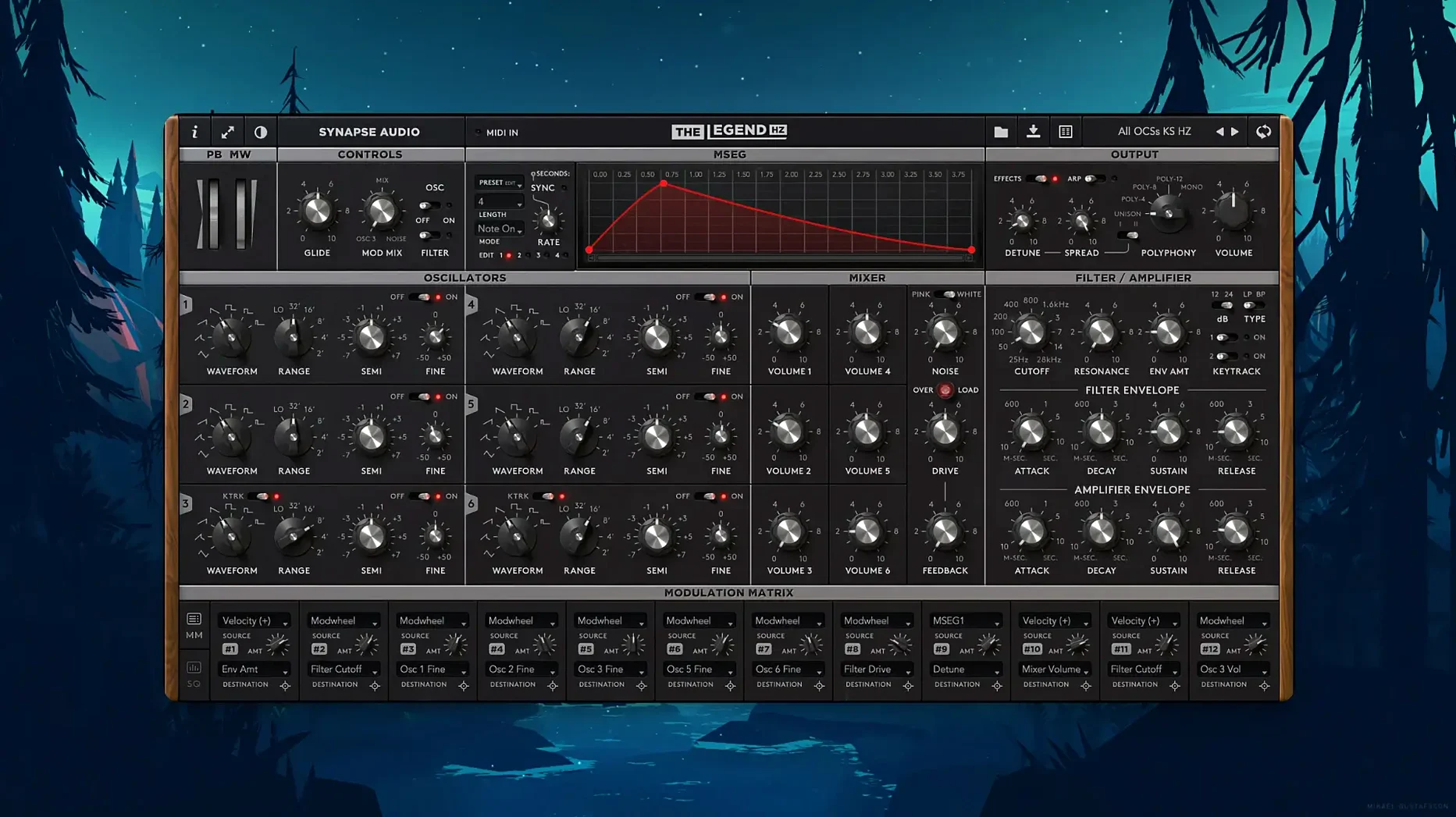
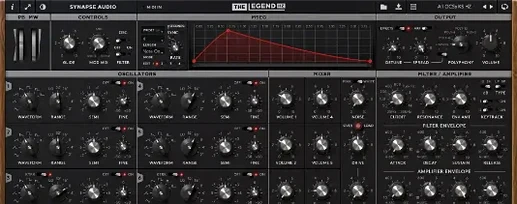
The Legend HZ is a software synthesizer plugin modelled on a Minimoog-style analog instrument, but it brings its own features on top of the classic blueprint.
Slots into Logic, Live, Pro Tools, and Komplete Kontrol
It comes in VST, AAX, and Audio Unit flavours, so it slots into Logic, Ableton Live, Pro Tools, and most other Mac DAWs without fuss. It also supports Native Kontrol Standard, which means Komplete Kontrol and Maschine users get a smooth, mapped experience. The plugin runs on macOS 10.14 and later, on both Intel and Apple Silicon machines.
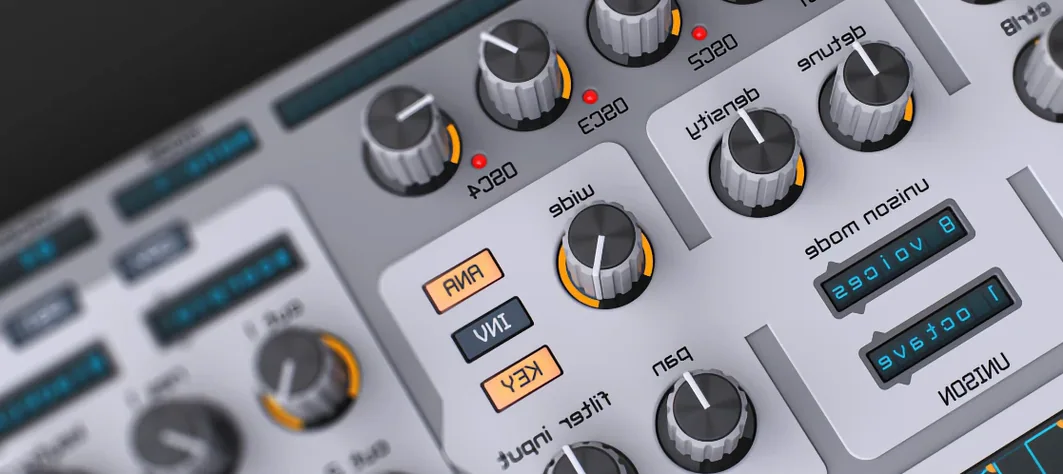
Adds a 914 Filter Bank, unison, and 12-voice polyphony
Under the hood, The Legend HZ adds a 914 Fixed Filter Bank, unison mode, and up to 12 voices of polyphony. Version 2.1 brings compressor saturation and a paragraphic equalizer on the back panel, plus 50 new factory presets by Kevin Schroeder. In total, you get 200 presets to start with. Patches and soundbanks made for the original The Legend load straight into HZ, so existing libraries keep working.
Explore 200 presets by Hans Zimmer and Kevin Schroeder
Once the plugin is in your VST, AAX, or Audio Unit folder and activated, spend some time with the 200 factory presets. Listen to how Hans Zimmer and Kevin Schroeder set up the filter bank, the modulation, and the arpeggiator. A few presets will show you what the six oscillators can do together — try turning off unison on a preset that uses it and hear the difference in thickness.
Go to the back panel and find the paragraphic equalizer and the compressor saturation. These are new in version 2.1 and live in a separate section. Turn the saturation up on a bass patch and see how it changes the sustain. The EQ is useful for shaping a sound before it hits your DAW's mixer, so you can work faster.
If you have patches or soundbanks from The Legend, load them into HZ. They will sound the same, but now you can layer them with HZ-specific effects. Keep both instruments in your session if you want — projects containing The Legend open the original, so you can use them side by side.
Does not replace the original The Legend
Some people ask whether The Legend HZ replaces The Legend. It does not. The two are separate plugins, and you can use both. The HZ version adds the filter bank, more oscillators, polyphony, and the newer effects. The original is still useful if you want the classic sound without the extra processing.
Another question is about system requirements. The plugin runs on macOS 10.14 and later, on both Intel and Apple Silicon. No Rosetta needed on an M-series Mac. It works in 64-bit hosts only, so check your DAW is 64-bit.
People also wonder if the presets from The Legend work here. They do. Patches and soundbanks load directly, and the HZ version can read them. The reverse is not true — HZ-specific features like the fixed filter bank will not work in the older instrument, but that is expected.
Paragraphic EQ saves you from reaching for another plugin
The biggest change is the paragraphic equalizer on the back panel. Before, you would shape the sound with the filter and the oscillator section. Now you can cut or boost specific frequencies inside the plugin, which saves you from reaching for an external EQ in your DAW. It is a subtle but practical addition for sound design and mixing.
Compressor saturation is another addition. It adds a warm, slightly compressed character to the sound. It is not a full compressor with attack and release controls, but it gives you that analogue feel without extra routing. Try it on leads and basses to get a more present tone.
MTS-ESP microtuning support means you can use alternative tuning systems with The Legend HZ. This is useful for composers working with non-standard scales or experimental music. If you use MTS-ESP in your DAW, the plugin follows the tuning automatically.
Finally, the 50 new presets by Kevin Schroeder expand the library to 200 total. They cover a range of sounds, from soft pads to aggressive leads, and they show off the new features well. If you already had version 2.0, these presets are worth loading just to see what the EQ and saturation can do in context.
- Added a paragraphic equalizer on the back panel.
- Added compressor saturation.
- Added MTS-ESP microtuning support.
- Added 50 factory presets by Kevin Schroeder.
- macOS 10.14 or later
- Intel or Apple Silicon
- Interface language: English
Kit check at a glance
| System | macOS 10.14 or later |
| Chip | Apple Silicon, Intel 64-bit |
| Download | 472 MB |
| Older pressings | 1 in the crate |


Chat from the booth
Sign in or grab a free account to leave a comment.
Nobody has said a word in the booth yet. If you played a set with this build, tell the next person how it went.