

- Build in the crate
- 1.0.5
- Made by the team at
- Rapid Flow
- Menu languages offered
- English
- How you pay for it
- K'ed by MORiA
- macOS it plays on
- macOS 10.14 or later
- CPU it runs on
- Apple Silicon, Intel 64-bit
Screenshots
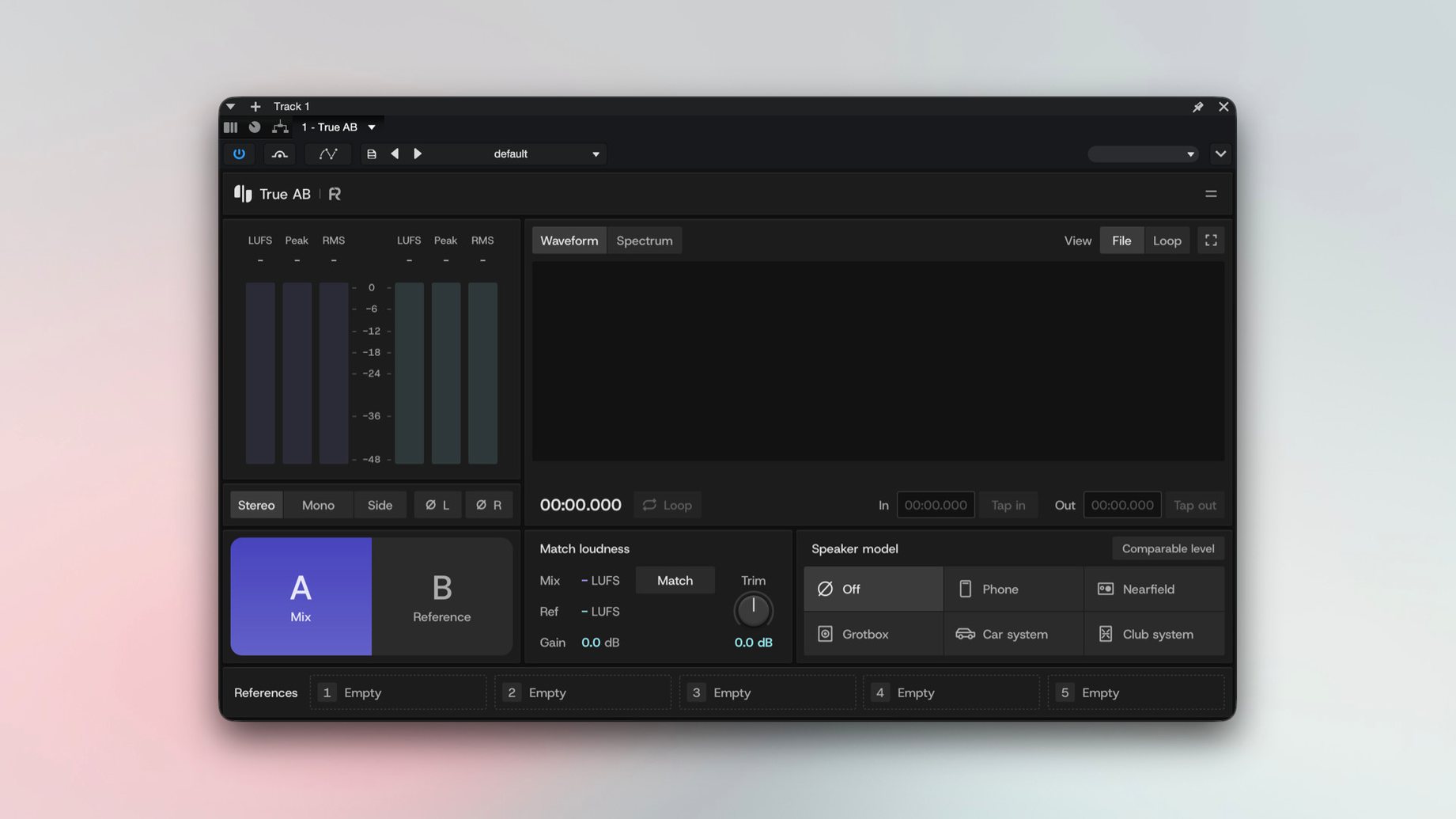
Rapid Flow True AB works on any Mac from macOS 10.14 onwards, supporting both Intel and Apple Silicon processors natively. The plugin lets you compare your mix against professional reference tracks, matching loudness between them so you hear the real difference, not just volume. It also checks how your mix translates to smartphone, car, and club systems.
Formats and hosts — Runs as an audio plugin in your DAW of choice. Supports ARM and 64-bit x86 architectures.
Analysis tools — True AB includes frequency balance analysis, so you can spot tonal issues while you reference.
Workflow — Load a reference track, match its loudness, then switch between your mix and the reference. Use it during mixing and mastering.
How True AB compares with similar Mac plugins
Most A/B reference tools for macOS fall into three camps: simple solo/mute switches, spectrum analysers with reference loading, or full session importers. True AB sits somewhere in the middle. It doesn't try to import full sessions like some heavyweights do, but it gives you more than a basic utility plugin.
Metric AB — Another popular reference plugin. Metric AB focuses on spectrum matching and detailed visual analysis of frequency content. True AB leans more into the listening side, with loudness matching that feels quicker to set up. Metric AB gives you a lot of numbers; True AB gives you the listening experience first, then the frequency analysis as a second check.
Reference 2 — A simpler tool that loads tracks and lets you switch between them. Reference 2 lacks the playback system simulation that True AB offers. If you need to check how your mix sounds on a small speaker or in a club, True AB has that built in. Reference 2 is lighter but less versatile for translation checks.
Ozone's reference module — Part of a larger suite, Ozone does matching and analysis well, but it's tied to its own ecosystem. True AB is a standalone plugin that works inside any DAW you already use. You don't need to change your workflow or learn a new mastering environment.
Skipping loudness matching
The most common error is skipping the loudness matching step. People load a reference track, hit play, and think their mix sounds weak or thin. Nine times out of ten, the reference is just louder. Let True AB do its loudness match first, then judge the tonal balance. The plugin is designed for comparison at equal volume — ignore that and you'll get misleading results.
Another mistake is comparing against only one reference track. The plugin supports up to five. Using one track can lock you into matching that single mix's quirks. Load two or three references from different genres or eras, and you'll get a clearer picture of where your mix sits. Beginners also tend to forget the mono check. They mix in stereo, listen on good speakers, and never flip to mono. True AB shows what details collapse in mono playback, which is how many club systems and phone speakers still work.
Muddy kick fix with three references
I had a mix open in my DAW — a four-on-the-floor techno track. The low end felt muddy, and I wasn't sure if the kick was punching through. I loaded True AB on the master bus and dropped in three reference tracks: a recent Ellen Allien track, an old-school Jeff Mills number, and something cleaner from Extrawelt.
First, I let the plugin match loudness for each reference. That took a few seconds per track. Then I started A/B switching between my mix and the Ellen Allien track. The difference was clear: my kick had too much sub and not enough mid punch. The loudness match made it obvious because the volume stayed constant between switches.
Next, I used the frequency analysis to look at the low end. My mix had a bump around 55 Hz, while the reference sat flatter. I cut a couple of dB there and checked again. The Jeff Mills track showed me that my hi-hats were too quiet in the high mids. A small EQ boost brought them out without making them harsh.
Finally, I ran the playback system simulators. On the smartphone setting, my bass almost disappeared. That told me the low end was too sub-heavy and not balanced with the upper bass. I adjusted a few levels, checked mono compatibility, and the mix held together. No surprises when I played it on a car system later.
- macOS 10.14 or later
- Intel or Apple Silicon processor
Kit check at a glance
| System | macOS 10.14 or later |
| Chip | Apple Silicon, Intel 64-bit |
| Download | 24 MB |






Chat from the booth
Sign in or grab a free account to leave a comment.
Nobody has said a word in the booth yet. If you played a set with this build, tell the next person how it went.